
Choosing a Bank Guarantee Provider: Credit Ratings, Due Diligence and Global Trade Finance


Bank Guarantee Providers
In international business, financial credibility can make the difference between securing a major contract and losing an important commercial opportunity. Whether a company is entering a new export market, bidding for an infrastructure project, negotiating a supply agreement or arranging project finance, the right financial assurances can help build confidence between counterparties.
This is why businesses increasingly investigate bank guarantee providers, highly rated issuing banks and structured trade finance solutions before committing to significant transactions.
However, choosing a bank guarantee provider involves much more than finding a company that advertises access to AAA-rated banks. Businesses must understand the issuing institution, the terms of the guarantee, the beneficiary's requirements, the transaction's costs and the legal and compliance considerations involved.
At Winter Hill Financial Services Limited, our approach centres on understanding each client's objectives and helping them explore appropriate bank guarantee (BG), Standby Letter of Credit (SBLC) and related financial instrument solutions. Through structured assessment, documentation support and attention to transaction requirements, we aim to help clients make informed decisions about their financing needs.
In this guide, we explain how bank guarantees work, what bank credit ratings mean, which factors to assess when selecting a provider and how businesses can approach international financial transactions with greater confidence.
What Is a Bank Guarantee?
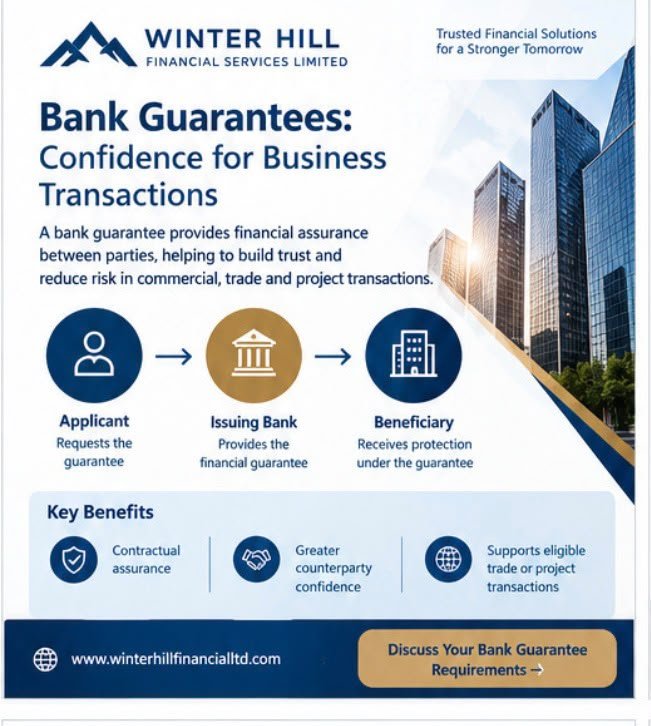
A bank guarantee is a contractual undertaking under which a bank agrees to pay a beneficiary if the conditions specified in the guarantee are satisfied. It is commonly used to support defined commercial, financial or performance obligations.
For businesses, a bank guarantee can provide additional assurance where one party needs confidence that the other party will meet its contractual commitments.
The principal parties generally include:
Applicant: The business or individual requesting the guarantee.
Beneficiary: The party receiving the protection under the guarantee.
Issuing bank: The financial institution undertaking the payment obligation.
Advising bank, where applicable: A bank that advises the guarantee to the beneficiary and may authenticate its apparent origin through the relevant banking process.
The exact roles depend on the transaction structure and the applicable documentation.
How does a bank guarantee work?
Consider a construction company bidding for a major infrastructure contract. The project owner requires financial assurance that the contractor will fulfil its obligations. The contractor applies to a bank for an appropriate guarantee.
Subject to the bank's approval, the guarantee is issued in favour of the project owner. If a claim is made in accordance with the instrument's terms, the issuing bank must assess the demand against the guarantee's requirements and honour a complying demand as provided by those terms.
A bank guarantee does not eliminate every commercial risk. Its value depends on the issuing institution, the guarantee wording, the claim conditions and the beneficiary's ability to enforce its rights.
For businesses comparing bank guarantee services, understanding these details should be an early priority.
Learn more about Bank Guarantee Services.
Why Do Businesses Look for AAA-Rated Bank Guarantee Providers?
When selecting a bank guarantee, the financial standing of the issuing institution can be an important consideration. This is one reason businesses investigate guarantees issued by banks with strong credit ratings.
A credit rating provides an independent opinion about an institution's or financial obligation's creditworthiness, depending on the rating being assessed. It can help counterparties compare credit risk, but it should not be treated as a complete measure of transaction safety.
An AAA rating generally represents the highest category on the long-term rating scales used by agencies such as S&P Global Ratings and Fitch Ratings. Moody's uses a different rating scale, so ratings should be compared within their appropriate frameworks.
Importantly, a bank does not automatically qualify as suitable for every guarantee simply because it has a high rating.
Businesses should consider whether the rating applies to the exact issuing legal entity, whether it is current, which agency assigned it and whether it relates to the relevant global or national rating scale.
What does a strong bank credit rating mean for your transaction?
A strong credit profile can provide useful information when assessing the institution expected to honour a guarantee. Nevertheless, the beneficiary may have additional requirements regarding jurisdiction, currency, guarantee wording, applicable rules and acceptable banking channels.
Before proceeding, establish:
The identity of the proposed issuing bank.
The legal entity that will issue the instrument.
The rating agency and current rating, where relevant.
Whether the rating is on a global or national scale.
The guarantee's governing rules and applicable law.
Whether the beneficiary has approved the issuing institution.
The bank's ability and willingness to issue the specific instrument.
The key is to assess the actual guarantee and its issuer rather than relying on a provider's marketing claims.
How to Choose the Right Bank Guarantee Provider
Finding a suitable bank guarantee provider requires a structured approach. A credible partner should be able to explain the proposed transaction, identify the roles of the participating institutions and clarify the documentation and approval process.
The following considerations can help businesses evaluate their options.
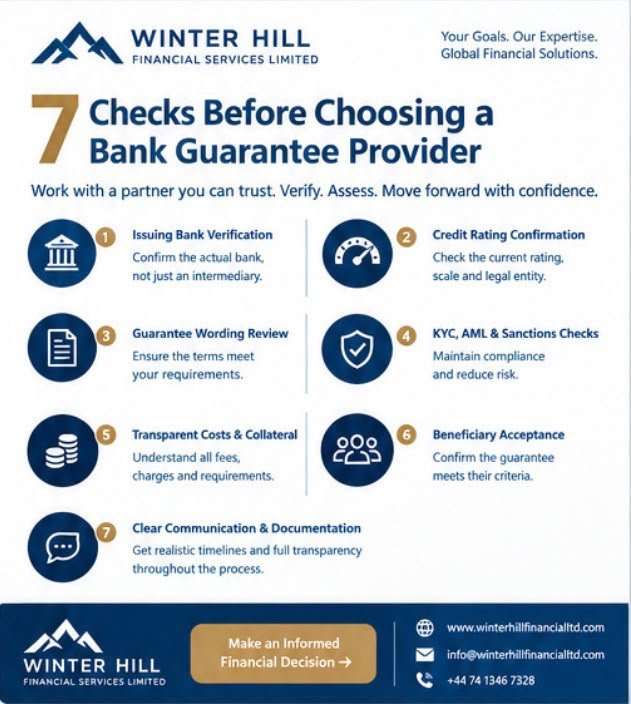
1. Verify the issuing bank and its credit rating
Start by asking which bank will issue the guarantee and which legal entity will assume the obligation.
If a provider refers to AAA-rated banks, request sufficient information to independently check the relevant rating through the rating agency's official publications or other reliable sources.
Confirm the rating's date, scale and scope. A national-scale AAA rating should not automatically be interpreted as equivalent to a global-scale AAA rating.
Also distinguish between an arranger, broker or adviser and the actual issuing bank. An intermediary may facilitate a transaction without itself assuming the bank's payment obligation.
2. Examine the provider's transaction process
A professional provider should be able to explain how it assesses client requirements, coordinates with relevant institutions, manages documentation and addresses compliance requirements.
Ask how the process works from the initial application through to proposed issuance, authentication and delivery.
Clarify which activities the provider performs directly and which are subject to a third-party bank's independent assessment and approval.
At Winter Hill Financial Services Limited, our published services include support with bank guarantees, SBLCs, financial instrument documentation and transaction-related due diligence. The appropriate scope of support depends on the client's circumstances and the proposed transaction.
3. Check the guarantee wording carefully
The wording of a bank guarantee determines the nature and scope of the issuing bank's undertaking.
Important provisions can include:
The applicant and beneficiary's legal names.
The maximum guaranteed amount and currency.
The obligations being supported.
Conditions for making a claim.
Expiry date and place of presentation.
Required supporting documents.
Applicable rules and governing law.
Reduction, extension or cancellation provisions, where relevant.
A guarantee with an unsuitable expiry date or unclear claim procedure may not meet the beneficiary's requirements, even if the issuing bank has a strong credit rating.
Where necessary, seek legal advice on the instrument's enforceability and its relationship with the underlying commercial contract.
4. Assess compliance and authenticity checks
Cross-border financial transactions can involve multiple jurisdictions, institutions and counterparties. Know Your Customer (KYC), Anti-Money Laundering (AML), sanctions screening and other compliance requirements may apply.
Before making a commitment, confirm how the transaction will be reviewed and how the authenticity of the proposed instrument will be established.
Where an instrument is intended to be issued or advised through SWIFT, its transmission and authentication should be confirmed through appropriate bank-to-bank procedures. A screenshot, copied message or document supplied by an intermediary is not, by itself, conclusive proof that a guarantee is authentic or operative.
Avoid relying solely on email assurances, unofficial verification contacts or promises that an instrument will be accepted without independent review.
5. Understand all fees, collateral and financial commitments
The cost of a bank guarantee depends on factors such as the issuing bank, guarantee amount, duration, applicant's creditworthiness, collateral arrangements and transaction structure.
Potential costs may include bank issuance charges, arrangement fees, legal expenses, advising or amendment fees and collateral-related costs.
Before signing, request a written breakdown that explains:
The purpose and amount of each fee.
When payments become due.
Whether any deposit is refundable.
The collateral or cash-margin requirements.
The conditions for issuance and release of security.
The consequences of cancellation, extension or non-completion.
Be particularly cautious of guaranteed issuance claims, unrealistic pricing or pressure to make substantial upfront payments without satisfactory documentation and verification.
6. Confirm that the guarantee meets the beneficiary's requirements
A guarantee is only useful for its intended purpose if the beneficiary can accept it.
Some project owners, lenders, procurement authorities and commercial counterparties specify acceptable banks, minimum credit criteria, approved wording or particular governing rules.
Obtain the beneficiary's requirements before arranging issuance. This can reduce the risk of paying for an instrument that later needs to be amended or replaced.
7. Evaluate communication and ongoing support
International guarantee transactions can involve detailed documentation and multiple parties. Clear communication is essential.
Look for a partner that explains the process in plain language, identifies outstanding requirements, communicates realistic timelines and distinguishes confirmed arrangements from matters that remain subject to approval.
A well-managed process should help you understand the transaction before you commit, rather than leaving important costs or conditions unclear until late in the process.
Types of Bank Guarantees and Related Financial Instruments
Different transactions require different forms of financial assurance. Businesses should identify the instrument that matches their contractual obligations rather than selecting one simply because it is available.
Performance bank guarantees
A performance guarantee supports obligations to perform under a contract. It may be requested in construction, engineering, infrastructure, procurement and other service agreements.
The wording should clearly identify the relevant obligations and the circumstances in which the beneficiary may make a claim.
Advance payment guarantees
An advance payment guarantee can protect a buyer or project owner that pays a supplier or contractor before the relevant goods or services have been delivered.
The amount, duration and reduction provisions should reflect the commercial arrangement and the beneficiary's requirements.
Financial guarantees
A financial guarantee supports a specified financial obligation, subject to the terms of the instrument. It may be relevant to payment commitments, financing arrangements or other agreed liabilities.
Tender and bid guarantees
A tender guarantee, sometimes called a bid guarantee, may be required during a procurement process to support a bidder's obligations under the tender conditions.
The amount, validity period and claim requirements should be checked against the tender documentation.
Standby Letters of Credit (SBLCs)
A Standby Letter of Credit is a separate documentary instrument that can provide payment or performance support if specified conditions are met. Its operation depends on its wording and applicable rules.
Although SBLCs and bank guarantees can serve similar commercial purposes, they are not interchangeable in every jurisdiction or transaction.
The beneficiary's instructions, the underlying contract and the applicable legal framework should determine which instrument is appropriate.
Winter Hill Financial Services Limited provides information and support relating to bank guarantees, SBLCs and other financial instruments, subject to the specific transaction and applicable requirements.

Bank Guarantees for International Trade and Project Finance
Bank guarantees can support transactions in which parties need additional assurance before committing resources or entering into contractual relationships.
International trade
Importers and exporters may use financial instruments to address concerns about payment, delivery, performance or other contractual obligations.
The appropriate instrument depends on the transaction, the parties' credit profiles and the requirements agreed between buyer and seller.
Construction and infrastructure
Large projects often involve substantial contract values, staged payments, tender requirements and performance milestones.
A guarantee can support particular obligations where the project owner requires additional financial assurance. Its value depends on the issuing institution and the enforceability and practical operation of the instrument.
Procurement and supplier agreements
Businesses purchasing equipment, raw materials or specialist services may be asked to provide guarantees as part of a supplier or procurement contract.
Early assessment of the required amount, wording and validity period can help prevent avoidable delays.
Project finance and structured funding
Some financing arrangements involve bank guarantees or SBLCs as part of a wider security package. Lenders will typically assess the instrument alongside the borrower's financial position, the project's cash flows, other collateral and the overall transaction structure.
A bank guarantee does not automatically secure project finance or guarantee that a lender will advance funds. Each funding decision remains subject to the relevant institution's underwriting, compliance and approval requirements.

Bank Guarantee Due Diligence: Red Flags to Avoid
Due diligence should be treated as a core part of every bank guarantee transaction, not as a final administrative step.
Watch for the following warning signs:
Unverifiable bank claims. A provider advertises access to AAA-rated institutions but will not identify the proposed issuer or provide information that can be independently checked.
Unclear transaction roles. It is difficult to establish which party arranges the instrument and which bank assumes the actual payment obligation.
Pressure to pay immediately. You are urged to transfer fees or collateral before receiving clear written terms and completing reasonable checks.
Promises of automatic acceptance. A provider claims that every beneficiary or lender will accept the guarantee without reviewing the requirements.
Inadequate authentication. The proposed verification process relies on screenshots, forwarded emails or documents that cannot be confirmed through appropriate banking channels.
Unexplained returns or monetisation claims. A party promises guaranteed profits, fixed funding outcomes or a predetermined percentage of an instrument's face value without credible contractual support and transparent risk disclosures.
Incomplete documentation. Important provisions covering fees, governing law, expiry, claims, collateral or dispute resolution are missing or unclear.
If you encounter these warning signs, pause the transaction and obtain independent financial, legal or compliance advice as appropriate.
A disciplined due diligence process helps businesses evaluate risk more effectively. It cannot remove every risk, but it can identify problems before they become costly.
Can a Bank Guarantee or SBLC Be Used for Monetisation?
Some businesses explore bank guarantee or SBLC monetisation to determine whether an eligible instrument can support access to working capital or a credit facility.
In a typical secured financing structure, a lender or specialist financing counterparty assesses the instrument, the issuing bank, the applicant or borrower, the proposed collateral arrangement and the intended use of funds.
The assessment may include:
- Verification of the instrument's authenticity and operative status.
- Review of the issuing bank and the instrument's wording.
- Credit and compliance assessment of the parties.
- Evaluation of the proposed loan-to-value ratio, fees and tenor.
- Agreement on repayment obligations, security and exit arrangements.
Monetisation is not automatic. An instrument's face value does not establish how much financing may be available, and a guarantee or SBLC may be unsuitable for a particular funding programme.
Businesses should assess the proposed facility's total cost, repayment terms, collateral exposure and legal obligations before proceeding.
Winter Hill Financial Services Limited offers BG/SBLC monetisation-related services for eligible instruments, subject to verification, counterparty assessment, compliance and the terms of the proposed arrangement.
Visit our BG/SBLC Monetisation Services to explore the process and key considerations.
How Winter Hill Financial Services Limited Approaches Bank Guarantee Solutions
Selecting a bank guarantee partner should begin with the commercial objective, not with the instrument itself.
At Winter Hill Financial Services Limited, we recognise that a guarantee required for a procurement contract may have different requirements from an instrument considered for an international trade or project finance transaction.
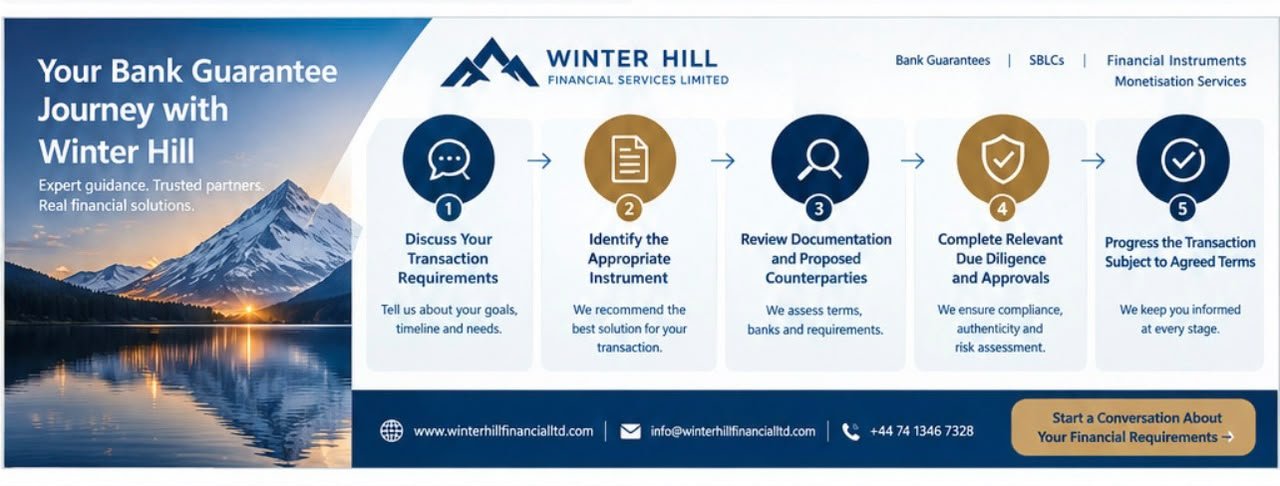
Our published service offering includes bank guarantees, SBLCs, related financial instruments and BG/SBLC monetisation. Depending on the client's requirements, support may involve understanding the proposed transaction, reviewing documentation, coordinating with relevant counterparties and considering applicable verification and compliance requirements.
Our approach is built around several practical principles:
Understanding the transaction
We first need to understand the underlying contract, the parties involved, the required instrument and the intended outcome.
Reviewing documentation and requirements
The amount, validity period, beneficiary requirements, claim provisions and relevant rules must be considered before a transaction is progressed.
Considering the issuing institution
The proposed bank's identity, relevant credit information and ability to issue the required instrument are important parts of the assessment.
Clarifying costs and conditions
Businesses should understand the proposed fees, collateral arrangements, approval conditions and contractual commitments before proceeding.
Maintaining clear communication
A well-structured process should make it easier for clients to understand what is confirmed, what remains subject to approval and what documentation is still required.
Every transaction is assessed on its own merits. The availability of an instrument, the suitability of a bank and any financing outcome depend on the relevant parties, due diligence and final contractual arrangements.
Discover Winter Hill Financial Services Limited and our wider range of financial solutions.
Frequently Asked Questions About Bank Guarantee Providers. What is a bank guarantee provider?
A bank guarantee provider is a term commonly used for a business or financial intermediary that helps arrange a bank guarantee. The provider may coordinate the application and documentation, but the issuing bank or other named guarantor is the party that undertakes the payment obligation under the instrument.
Always establish the precise role of each party before entering into an agreement.
How do I find a bank guarantee provider working with AAA-rated banks?
Begin by identifying the issuing institution and independently verifying its current credit rating, rating scale and legal entity. Then review the proposed guarantee, the beneficiary's requirements, the transaction's compliance arrangements and all associated costs.
Do not rely solely on promotional statements about access to highly rated banks.
Does an AAA-rated bank guarantee guarantee acceptance?
No. A strong rating may be relevant to the beneficiary's assessment, but acceptance also depends on the beneficiary's policies, the instrument's terms, the issuing bank's eligibility, applicable law and other transaction-specific requirements.
What documents may be required for a bank guarantee?
Depending on the transaction, the issuing institution may request corporate and identity documents, financial statements, the underlying contract, details of the beneficiary, an application form and information about the proposed amount, currency and validity period.
Additional credit, collateral, compliance and legal documents may be necessary.
How long does it take to arrange a bank guarantee?
There is no universal timeline. Processing time depends on the issuing bank, the applicant's financial profile, the complexity of the transaction, documentation completeness, compliance checks and the beneficiary's requirements.
Obtain a realistic estimate for your particular case rather than relying on an unconditional promise of rapid issuance.
Can a bank guarantee help a business obtain funding?
It may form part of a wider financing or security arrangement, but it does not automatically qualify a business for a loan. A lender will assess the instrument alongside the borrower, repayment capacity, collateral and transaction risks.
What is the difference between a bank guarantee and an SBLC?
Both instruments can provide financial assurance, but they operate under their respective terms and legal frameworks. The appropriate choice depends on the underlying transaction, beneficiary requirements and applicable rules.
Is bank guarantee monetisation guaranteed?
No. Monetisation depends on the instrument's eligibility, authenticity, the financing counterparty's assessment, compliance requirements and the final agreed terms. Businesses should be wary of claims that financing is automatic or that a specific amount will always be released.
Final Thoughts: Choose a Bank Guarantee Partner Through Verification, Not Promises
A bank guarantee can play an important role in supporting trade, procurement, construction, infrastructure and other commercial transactions. However, its usefulness depends on much more than the issuing bank's headline credit rating.
Businesses should verify the issuing institution, assess the instrument's wording, confirm the beneficiary's requirements, understand all costs and complete appropriate due diligence before committing funds or signing contracts.
The right partner should help clarify the transaction, explain the risks and support a properly documented process. No provider can remove every financial or legal risk, and the final outcome remains subject to bank approval, compliance and contractual terms.
At Winter Hill Financial Services Limited, we support clients exploring bank guarantees, SBLCs and related financial solutions with a focus on transaction requirements, documentation and informed decision-making.
Planning a bank guarantee or SBLC transaction?
Contact Winter Hill Financial Services Limited to discuss your requirements and explore whether our services may be suitable for your proposed transaction. Website: https://winterhillfinancialltd.com
Brokers, Intermediaries and Consultant are welcome to bring their clients 100% protected. Our brokers receive 2% commission for referral. We assist Clients and brokers in their attempt to secure funding by working on their funding requests that may require innovative financing. In complete confidence, we will work together for the benefits of all parties involved.