Best SBLC Providers: Top Trusted Standby Letter of Credit Partner for Trade Finance and Project Funding
Finding the Right SBLC Provider
The interconnected business environment, access to reliable financial instruments can play an important role in international trade, commercial agreements and large-scale project development. Businesses operating across borders must often demonstrate financial credibility, secure contractual commitments and manage the risks associated with transactions involving multiple counterparties.
One instrument frequently used for these purposes is the Standby Letter of Credit (SBLC).
An SBLC is a bank undertaking designed to provide financial protection to a beneficiary if the applicant fails to meet specified obligations under the instrument's terms. Depending on the transaction, it may support international trade, contractual performance, project financing arrangements or other approved commercial requirements.
However, finding the right SBLC provider involves more than comparing fees or looking for the fastest processing time. Businesses must understand the issuing bank, the instrument's terms, the beneficiary's requirements, the transaction structure and the relevant compliance procedures.
This guide explores what makes an SBLC provider suitable, how standby letters of credit work, what businesses should verify before proceeding, and how specialist financial services firms can help coordinate the process.
Winter Hill Financial Services Limited supports clients exploring financial instruments, including Standby Letters of Credit, Bank Guarantees and BG/SBLC monetization, alongside broader business and project finance solutions. Its published services provide a starting point for businesses seeking to understand the available options and assess their funding requirements.
If your business is considering an SBLC for an international transaction or project, understanding the instrument before committing to a structure can help you make a more informed decision.
1. What Is a Standby Letter of Credit (SBLC)?
A Standby Letter of Credit is a financial instrument issued by a bank on behalf of an applicant to provide payment assurance to a named beneficiary, subject to the instrument's terms and presentation requirements.
Unlike an ordinary payment arrangement, an SBLC is generally intended to serve as a secondary source of payment if the applicant fails to fulfil a specified obligation. The beneficiary must satisfy the conditions set out in the instrument to make a valid demand.
For example, an importer may need to reassure an overseas supplier that payment obligations are supported by an acceptable financial institution. Subject to the agreement between the parties and the issuing bank's approval, an SBLC may provide the required contractual assurance.
How does an SBLC work?
The process generally involves the following stages:
Commercial agreement: The applicant and beneficiary establish the underlying transaction and determine whether an SBLC is required.
Application and assessment: The applicant approaches an eligible issuing bank or an appropriate financial intermediary. The bank assesses the applicant, the transaction and the proposed terms.
Instrument preparation: The parties agree on the amount, expiry date, governing rules where applicable, and conditions for making a demand.
Issuance and authentication: The issuing bank issues the instrument using an agreed delivery method. Where applicable, banks may use SWIFT messaging to communicate the undertaking.
Monitoring and expiry: The parties monitor compliance with the instrument's conditions and its expiry date. If the applicant defaults, the beneficiary may make a demand in accordance with the instrument.
An SBLC does not automatically provide cash to its applicant, nor does its existence guarantee that a lender will provide additional funding. Its usefulness depends on the commercial purpose, wording, issuer and acceptance criteria of the relevant parties.
For businesses considering this instrument, reviewing the proposed structure before applying is essential.
2. Why Choosing the Right SBLC Provider Matters
Selecting an appropriate SBLC provider can affect the practicality, cost and timing of a transaction.
Not every provider has the same role. Some are banks that issue instruments directly, while others are financial advisers, arrangers or intermediaries that coordinate applications and transactions involving third-party institutions.
Understanding this distinction helps businesses establish what a provider can actually deliver.
Key factors to evaluate
Issuing bank credibility
The identity and standing of the issuing bank can be central to whether an SBLC is accepted. Verify the institution independently and confirm that the proposed instrument can meet the beneficiary's requirements.
Clear documentation
The amount, currency, expiry date, governing rules, presentation requirements and other material conditions should be documented clearly. The wording should be reviewed before issuance.
Compliance and due diligence
Applicants should expect appropriate identity verification, know-your-customer (KYC) checks, anti-money-laundering (AML) procedures and assessment of the transaction's commercial purpose.
Transparent fees
Request a written breakdown of applicable fees, commissions, bank charges, collateral requirements and any third-party costs. Clarify when payments become due and whether they are refundable.
Realistic timelines
Issuance depends on the bank's underwriting, documentation, compliance checks and transaction complexity. No intermediary should be assumed capable of guaranteeing a particular outcome or timeline.
Beneficiary acceptance
An instrument is only useful for its intended purpose if the beneficiary, lender or relevant counterparty accepts its issuer and terms. Confirm the requirements before incurring significant costs.
Winter Hill's published financial services include guidance on SBLCs, Bank Guarantees and other financial instruments. Businesses can use an initial discussion to clarify their objectives, requirements and potential transaction structure.
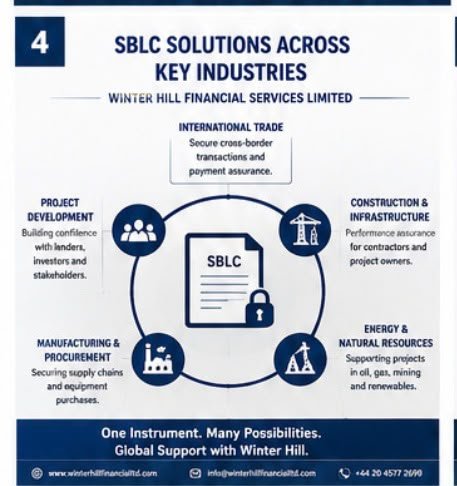
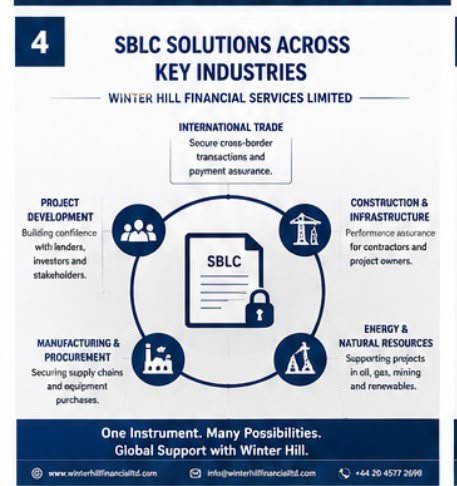
3. What Types of Businesses Use SBLCs?
Standby letters of credit may support different commercial arrangements, depending on the transaction and the parties involved.
International trade and import-export
An importer may be required to provide payment assurance to an overseas supplier. An SBLC can potentially support the arrangement where the supplier accepts the instrument and the issuing bank approves the application.
Construction and infrastructure
Contractors and project sponsors may need to demonstrate financial assurance when entering into substantial commercial agreements. An SBLC may be considered where its terms are appropriate to the contractual obligation.
Energy and natural resources
Certain energy, commodities and infrastructure transactions involve counterparties operating in different jurisdictions. A suitable standby undertaking may help address defined payment or contractual risks.
Manufacturing and procurement
Businesses purchasing machinery, equipment or substantial quantities of materials may encounter counterparties that require additional financial security before proceeding.
Project development
Developers seeking external funding may explore financial instruments as one component of a wider financing structure. However, an SBLC does not replace a viable business plan, acceptable project economics, borrower due diligence or a lender's independent approval.
In each case, the underlying commercial agreement determines whether an SBLC is appropriate. Businesses should not assume that the same instrument or terms will suit every industry.
4. SBLC for Project Financing: What Businesses Need to Know
Project financing often involves several stakeholders, including project sponsors, lenders, investors, contractors and suppliers. Each party may have different expectations concerning repayment, security, project completion and risk allocation.
An SBLC may form part of a proposed financing structure when a relevant counterparty requires an eligible standby undertaking.
However, its acceptance depends on the details of the arrangement.
Before proceeding, project sponsors should establish:
- The specific purpose the SBLC is expected to serve.
- Whether the proposed lender or beneficiary accepts the issuing bank.
- The required face value, currency and validity period.
- Whether cash collateral or other security is required.
- The conditions governing a demand under the instrument.
- The costs, financing obligations and potential liabilities.
- The legal, regulatory and compliance requirements in each relevant jurisdiction.
A provider should also help clarify the difference between arranging an instrument and securing funding against it. These are separate activities, and approval for one does not guarantee approval for the other.
Can an SBLC help secure project funding?
Potentially, yes. Where a lender accepts an SBLC as suitable security, it may contribute to the lender's assessment of a financing proposal.
Nevertheless, lenders determine whether to provide credit based on their own criteria, which may include the applicant's financial position, the instrument's enforceability, collateral, project viability and repayment capacity.
Businesses should therefore assess the entire funding structure rather than relying on the SBLC alone.
5. SBLC vs Bank Guarantee: Understanding the Difference
Standby Letters of Credit and Bank Guarantees are both used to provide financial assurance, but they are not interchangeable in every situation.
The terminology, legal treatment and demand requirements depend on the instrument's wording, governing rules and applicable law.
| Feature | Standby Letter of Credit | Bank Guarantee |
|---|---|---|
| General purpose | Provides payment assurance following specified non-performance or default | Provides financial assurance for an agreed obligation |
| Typical applications | Trade, contractual obligations and eligible financing structures | Contract performance, payment obligations, tenders and other agreed commitments |
| Demand requirements | Defined by the standby instrument | Defined by the guarantee |
| Governing framework | May incorporate ISP98, UCP 600 or other applicable terms | Depends on the instrument, applicable law and any incorporated rules |
| Acceptance | Depends on the beneficiary and transaction requirements | Depends on the beneficiary and transaction requirements |
The appropriate choice depends on what the underlying contract requires and which instrument the beneficiary is prepared to accept.
For instance, a supplier may specifically require an SBLC, while a construction contract may call for a performance guarantee in a particular form. Substituting one for the other without approval could cause delays or contractual problems.
Before arranging either instrument, businesses should have the beneficiary's requirements reviewed and ensure that the proposed wording matches the transaction.
Explore Winter Hill's Bank Guarantee and financial instrument services
6. SBLC vs Bank Guarantee: Understanding the Difference
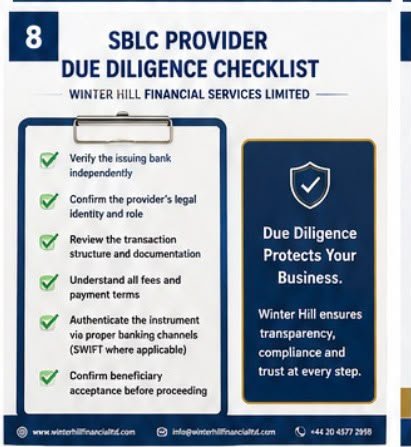
Due diligence is an essential part of selecting a financial services provider. Businesses should establish exactly who will issue the instrument, what role the intermediary will play and how the proposed transaction will be verified.
Verify the issuing institution independently
Obtain the issuing bank's legal name and confirm its identity through official channels. Do not rely exclusively on a logo, certificate, email or document supplied by an intermediary.
Where an instrument is expected to be transmitted through SWIFT, clarify the proposed bank-to-bank process and ask the relevant financial institution to explain how authenticity will be established.
SWIFT messaging is a communications mechanism; the reference to SWIFT alone does not prove that a financial instrument is genuine or acceptable.
Review the provider's legal identity and role
Determine whether the firm acts as a direct issuer, arranger, adviser, broker or financing intermediary. Verify the relevant legal entity and any claimed authorisations through the appropriate official registers.
If a firm claims to be regulated, check the claim independently and establish which activities and legal entity the authorisation covers. Regulatory status should never be inferred from marketing language alone.
Request a clear transaction proposal
A credible proposal should explain the instrument, the proposed issuer, the transaction's stages, fees, required documentation, approval conditions and expected responsibilities of each party.
Be cautious of proposals that omit essential information or use vague descriptions of banking relationships.
Examine contracts and payment conditions
Review all contracts before transferring money. Understand the payment schedule, cancellation rights, refund conditions, security arrangements and circumstances in which the transaction may not proceed.
Independent legal advice may be appropriate for substantial or cross-border transactions.
Watch for unrealistic promises
Treat claims of guaranteed monetization, risk-free returns, guaranteed project funding or automatic acceptance by major banks with caution.
An SBLC is a contractual undertaking, not a guarantee of investment profit or an unconditional promise that a third party will lend against it.
Confirm beneficiary requirements before committing
The beneficiary or lender should confirm what type of instrument it accepts, which issuers are eligible and what wording is required. This simple step can help avoid arranging an instrument that does not meet the transaction's needs.
8. Why Consider Winter Hill Financial Services Limited?
Businesses exploring standby letters of credit often need more than an introduction to the instrument. They may also need to understand how an SBLC fits into a wider funding strategy, how it compares with a Bank Guarantee, and what requirements apply before a transaction can progress.
Winter Hill Financial Services Limited publishes a range of financial services covering specialist financial instruments, business lending and BG/SBLC monetization.
Financial instruments and SBLC guidance
Winter Hill's published services describe support relating to SBLCs, Bank Guarantees and Letters of Credit. The focus is on understanding the instrument's purpose, documentation, terms and relevance to the client's financing objectives.
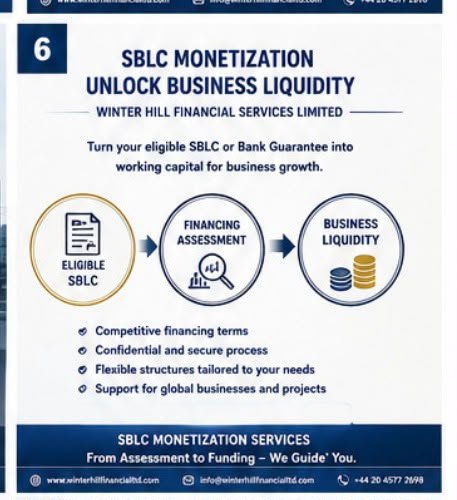
BG/SBLC monetization
Businesses holding an eligible instrument may explore whether it could support a financing facility. Any proposed arrangement remains subject to instrument eligibility, counterparty acceptance, compliance checks and agreed financing terms.
Business and project finance
Where a company is seeking working capital, expansion funding or project-related finance, it may be useful to consider the underlying funding requirement alongside any proposed bank instrument.
A structured process
Winter Hill outlines a process that includes an initial discussion, analysis, recommendations, implementation and ongoing review. The appropriate steps and services depend on the client's circumstances and the nature of the proposed transaction.
Transparent communication
Understanding the fees, responsibilities, approval requirements and potential risks before proceeding is essential in any structured finance transaction.
No provider can guarantee that an issuing bank will approve an application, that a beneficiary will accept a particular instrument or that a financing counterparty will offer monetization.
The most useful first step is to define the commercial objective and establish whether the proposed instrument is appropriate.
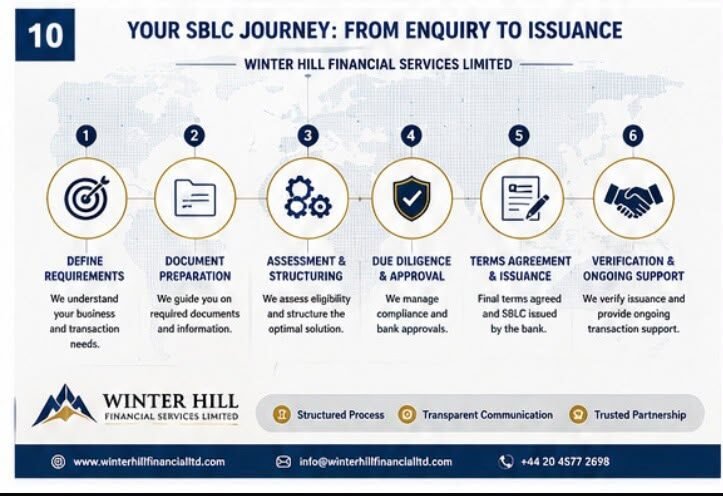
9. The SBLC Application Process: What to Expect
Although the exact process varies between institutions and transactions, businesses can generally expect several stages when exploring a standby letter of credit.
Step 1: Define the commercial requirement
Identify why the instrument is needed, who the beneficiary is, the required amount, the currency, the expiry date and any contractual requirements.
Step 2: Prepare the supporting documentation
Depending on the application, documentation may include company registration records, ownership information, financial statements, identification documents, transaction contracts and details of the proposed use.
The issuing bank or intermediary should specify the documents required for the particular case.
Step 3: Assess the proposed structure
Review whether the instrument is suitable for the commercial purpose, whether the beneficiary accepts the proposed issuer and whether collateral or other financial commitments are necessary.
Step 4: Complete compliance and underwriting
The relevant institutions perform their own due diligence, risk assessments and approval procedures. Submission of documents does not mean that the application has been approved.
Step 5: Agree the final terms
Before issuance, confirm the instrument's wording, costs, validity, demand conditions and any other material contractual provisions.
Step 6: Issue, verify and monitor the instrument
Once approved and issued, the parties should use the agreed authentication process and retain the relevant documentation. They should also monitor expiry dates and ensure that any obligations under the instrument are understood.
For businesses seeking guidance, an initial discussion with Winter Hill may help clarify the information needed to assess their requirements.
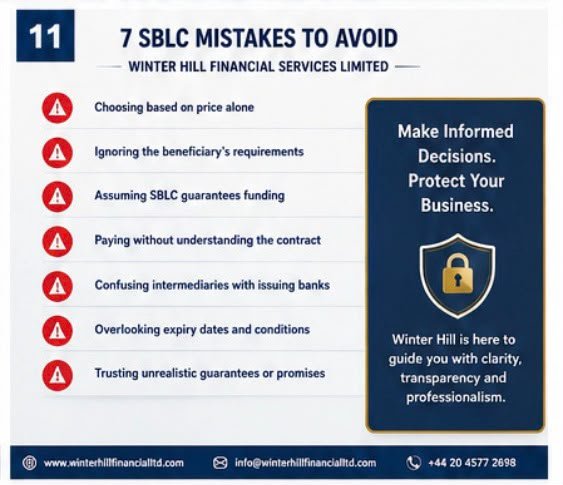
10. Common Mistakes to Avoid When Selecting an SBLC Provider
Businesses can reduce avoidable transaction risks by looking beyond promotional claims and considering the practical details of an instrument.
Choosing on price alone
A low quoted fee is not necessarily evidence of a suitable or credible transaction. Evaluate the issuer, contractual wording, total costs and acceptance requirements.
Assuming an SBLC guarantees financing
An SBLC may contribute to a lender's assessment but does not oblige every lender to provide a loan or advance funds.
Ignoring the beneficiary's requirements
The intended recipient should confirm the acceptable issuer, wording and delivery process before an application progresses too far.
Paying without understanding the contract
Establish what each payment covers, when it becomes due and what happens if the application is declined or the transaction cannot proceed.
Confusing an intermediary with an issuing bank
A firm arranging an instrument does not necessarily issue it. Clarify the legal roles of all parties involved.
Overlooking expiry dates and demand conditions
An instrument's effectiveness depends on its actual terms. Expiry dates, required documents and presentation conditions must be understood before the instrument is relied upon.
Accepting guaranteed-outcome claims
No general statement about an SBLC should be treated as a guarantee of issuance, acceptance, monetization or financing. Each transaction requires its own assessment.
11. Frequently Asked Questions About SBLC Providers: What is an SBLC provider?Heading Text Here
The term may refer to a bank that issues a Standby Letter of Credit or a financial services firm that helps arrange, review or coordinate an SBLC transaction. Businesses should confirm the provider's exact role before proceeding.
Who are the best SBLC providers in 2026?
The most suitable provider depends on the transaction, jurisdiction, instrument requirements, beneficiary's acceptance criteria and the applicant's financial position. Businesses should prioritise verifiable issuing institutions, clear documentation, compliance and transparent commercial terms rather than relying on a generic ranking.
Can Winter Hill Financial Services Limited help with SBLC requirements?
Winter Hill publishes services relating to Standby Letters of Credit, Bank Guarantees, financial instruments and BG/SBLC monetization. Prospective clients can review its services and make an enquiry to discuss their particular requirements. Any proposed transaction remains subject to the relevant assessment, approvals and terms.
How much does an SBLC cost?
Costs depend on factors such as the issuing institution, instrument amount, validity period, applicant's creditworthiness, collateral requirements and transaction structure. Fees may include bank charges, arrangement fees and other costs. Request a written quotation and full cost breakdown rather than relying on a general market estimate.
How long does SBLC issuance take?
There is no universal timeframe. Processing depends on the institution's underwriting and compliance procedures, the completeness of the documentation, the instrument's wording and the complexity of the transaction. A proposed timeline should be confirmed with the relevant parties and should not be treated as a guarantee.
What is SWIFT MT760?
MT760 is a SWIFT message type traditionally used for the issuance or communication of guarantees and standby letters of credit between financial institutions. The precise message flow depends on the transaction and the applicable SWIFT standards. A reference to MT760 alone does not establish the authenticity or acceptability of an instrument.
Can an SBLC be monetized?
Some eligible SBLCs may be considered as collateral for financing. Whether funding is available depends on the issuer, instrument terms, counterparty's policies, collateral and legal requirements. Monetization is not automatic, and the instrument's face value does not determine the amount that can be borrowed.
Is an SBLC the same as a Bank Guarantee?
No. Both instruments can provide financial assurance, but their legal treatment, wording and demand conditions may differ. The appropriate choice depends on the contract, the beneficiary's requirements and the relevant legal framework.
Can a startup apply for an SBLC?
A startup may explore an application, but eligibility depends on the issuing institution's underwriting standards, the company's financial position, available security and the proposed transaction. There is no universal rule that every startup will qualify.
What documents are required for an SBLC application?
Requirements vary. They may include company documents, identification and ownership records, financial statements, underlying contracts and details of the transaction. The relevant institution should provide a transaction-specific checklist.
Does an SBLC guarantee that a project will receive funding?
No. An SBLC may support a financing proposal if the lender accepts the instrument, but project funding remains subject to the lender's underwriting, legal review, project viability and other conditions.
How can a business check whether an SBLC is genuine?
Businesses should independently verify the issuing institution, use appropriate bank-to-bank authentication procedures, review the instrument's terms and seek qualified legal or financial advice where necessary. Documents, email confirmations and logos should not be treated as conclusive proof on their own.
Conclusion: Choosing an SBLC Partner With Confidence
Finding an appropriate Standby Letter of Credit provider in 2026 requires careful evaluation of the instrument, the issuing institution, the proposed transaction and the parties involved.
For businesses engaged in international trade, project development or structured financing, an SBLC may provide valuable contractual assurance when it is designed for the right purpose and accepted by the intended beneficiary. Where financing against an existing instrument is being considered, eligibility and commercial terms must be assessed independently.
The most important considerations remain consistent: verify the issuer, understand the documentation, assess the total costs, confirm beneficiary acceptance and never assume that an instrument guarantees funding or a particular financial outcome.
Winter Hill Financial Services Limited publishes services covering SBLCs, Bank Guarantees, financial instruments and BG/SBLC monetization, alongside business and project finance solutions. Businesses can explore these services to understand which options may be appropriate for their circumstances.
Are you exploring an SBLC for trade finance, contractual assurance or a project financing requirement?
Start by defining your commercial objective and reviewing the instrument requirements. Then speak with a suitable financial services professional about the available options, documentation and next steps.
Explore Winter Hill Financial Services Limited
Review SBLC and financial instrument services
Contact: Winter Hill Financial Services Limited to discuss your business objectives and explore the available options.
Brokers/ Intermediaries/ are welcome to bring their clients 100% protected. Our brokers receive 2% commission for referral. We assist Clients and brokers in their attempt to secure funding by working on their funding requests that may require innovative financing. In complete confidence, we will work together for the benefits of all parties involved