
Financing Greenhouse and Agricultural Infrastructure in Today’s Financial Landscape

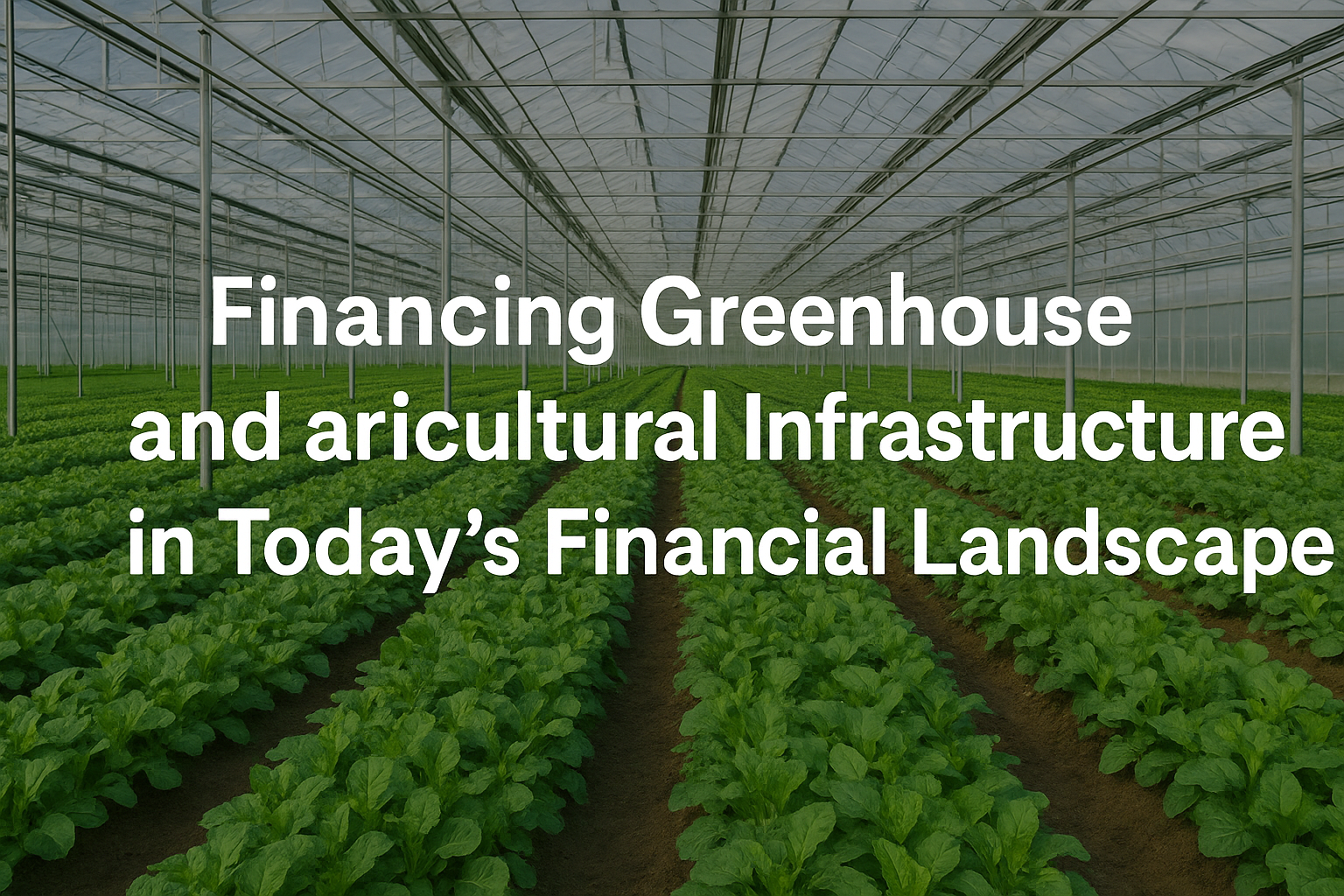
How Winter Hill Financial Services Can Help You Secure the Capital You Need
Agriculture is no longer just about planting seeds and harvesting crops. In many parts of the world, modern farming integrates sophisticated systems — including floriculture, horticulture, irrigation, climate control, and digital monitoring. To realize such a vertically integrated vision, the foundational infrastructure (greenhouses, automated systems, processing units) must be robust, scalable, and well-financed.
That’s where Winter Hill Financial Services Limited steps in. We specialize in providing international loans, business financing, and financial modeling for infrastructure projects — especially in the agricultural and agritech space. But funding a successful greenhouse project involves more than just one big loan. It requires layered financing, structuring, and strategic support.
In this long read, we’ll walk you through:
- The components of greenhouse/agribusiness projects that demand funding
- The most viable financing sources available today
- How investors, grants, and venture capital fit in
- Why Winter Hill is uniquely positioned to help
1. The Multi-Dimensional Nature of Greenhouse Projects
When you envision a greenhouse farm, you’re not just imagining rows of plants. You’re planning an integrated system that includes:
- The greenhouse structure itself (glass, polycarbonate, or hybrid materials)
- Climate control systems (ventilation, heating, cooling, shading)
- Irrigation and fertigation (drip lines, pumps, filters, nutrient injectors)
- Sensor networks, IoT, automation, and data systems
- Soil or substrate systems, hydroponics or soilless media
- Seedling and propagation infrastructure
- Storage, processing, cooling, and logistics infrastructure
- Maintenance, repair, and eventual replacement schedules
- Working capital (inputs, labor, energy, consumables)
Each of these components requires capital, and many require different risk profiles, maturity timelines, and repayment structures. The financing solution must knit all of these pieces into a coherent, stage-wise capital plan.
Because modern greenhouse operations can also include side streams such as floriculture, vertical farming, or integrated horticulture, the financial model must account for interdependencies (e.g. shared energy or water systems) and revenue diversification.
2. Core Financing Channels in the Global Context
Let’s examine, in today’s financial climate, the most reliable and practical funding pathways.
2.1 Bank Loans & Agricultural Finance
Traditional bank loans remain among the most stable and accessible forms of financing — especially for infrastructure build-outs and long-lived assets. Around the world, commercial banks and agricultural development banks offer specialized loan products to greenhouse and agribusiness operators.
Key features often include:
- Extended tenors (5–20 years) tied to the lifespan of infrastructure
- Grace periods allowing operations to stabilize before principal repayments begin
- Variable or fixed interest rates (depending on local macroeconomics and central bank policies)
- Collateral or asset-based security
- Structured drawdowns linked to project milestones
In many countries, governments support such lending via guarantee schemes or interest subsidies. So borrowers can get credit on more favorable terms.
However, banking criteria are tougher now — under Basel III/IV rules and more stringent environmental, social, and governance (ESG) assessments. Lenders often require comprehensive project studies, risk mitigation, environmental impact assessments, and robust financial models.
2.2 Corporate or Specialty Lenders & “Reliance-style” Options
Some financial intermediaries (e.g. specialized agrifinance firms, microfinance institutions, or private agricultural lenders) offer more flexible financing options than traditional banks. In your original reference, you mentioned “Reliance Money” as an example — institutions like that often cater to:
- Smaller or fragmented farmers
- Specific capital goods (e.g. drip irrigation, cold storage, greenhouse modules)
- Shorter tenor loans or leases
- Bundled services (equipment supply + finance)
These lenders may accept alternative collateral types, more lenient underwriting for well-conceived business plans, and even partial government guarantees.
2.3 Grants, Subsidies, and Public Funding
To stimulate agricultural innovation, many governments and foundations offer grants or subsidies. These funds are particularly useful for high-impact projects (e.g. energy-efficient greenhouses, clean water systems, climate resilience). Some common sources include:
- National or federal agricultural grants
- State, provincial, or county incentive funds
- Environmental and climate adaptation funds
- Private foundations and philanthropic institutions
- International development agencies (World Bank, USAID, FAO, EU funds)
Grants are non-dilutive (you don’t repay), but they are highly competitive. The application process can take months (3–6 months or more), and it requires meticulous alignment with funders’ priorities, formatting, and reporting. Many organizations now hire or partner with grant writers or philanthropic advisors to maximize success.
2.4 Private Investors, Equity, and Debt Financing
When your greenhouse project demonstrates clear scalability, profitability, and competitive advantage, it becomes attractive to private capital. Here are common investor structures:
- Angel investment: Early-stage equity capital from high-net-worth individuals who often bring domain experience
- Equity financing: Selling ownership stakes in exchange for capital and sometimes strategic partnership
- Debt financing by private institutions: Non-bank lenders may offer more flexible terms, though often at higher interest
- Convertible debt: Debt that can convert to equity under certain conditions
To approach investors, you’ll need a strong business toolkit: executive summary, full business plan, pro forma financial statements, market research, risk analyses, and a solid pitch deck. Investor due diligence is rigorous.
2.5 Venture Capital & Corporate Venture Arms
For greenhouse ventures that incorporate disruptive or tech-driven elements (e.g. vertical farming, AI-based climate control, novel substrates, energy optimization), venture capital (VC) becomes a compelling path. VC firms look for projects with:
- High growth potential
- Scalability and defensible competitive edge
- Strong management/technical team
- High-margin or recurring-revenue models
Corporate venture capital (CVC) arms — investment divisions of larger agribusiness, energy, or tech companies — also play a role. They invest in early-stage ventures that can potentially integrate into their value chains (supply, distribution, R&D). In successful cases, VC or CVC investors may propose joint ventures, acquisitions, or collaboration agreements.
However, venture capital is typically more patient capital (5–10-year horizon) and expects higher returns in exchange for risk. In many cases, combining VC funding with grants and strategic debt yields the optimal capital stack.
2.6 Hybrid & Layered Capital Structures
The most resilient financing plans often blend several sources — sometimes called a capital stack:
- Senior debt (bank loans or structured loans)
- Mezzanine financing or subordinated debt
- Equity / investor financing
- Grants or subsidies (non-dilutive)
This structure helps lower the weighted cost of capital, distribute risk, and match cash flows to repayment schedules.
3. How Winter Hill Financial Supports Your Project
Winter Hill Financial Services is more than a lender — we are your strategic capital partner. Our offerings include:
- Project finance advisory
- Advanced financial modeling and feasibility studies
- Structuring optimal capital stacks
- Loan guarantees, credit enhancement mechanisms, risk mitigation
- Access to investor networks and philanthropic capital
- Ongoing financial and performance monitoring and consulting
We help you build robust models — sensitive to commodity price fluctuations, interest rate changes, climate risk, operational variances — so lenders and investors gain confidence in your projections.
We also adapt to the evolving global financial landscape: with tighter ESG requirements, climate risk disclosure expectations, and increasing scrutiny from multilateral finance institutions, it’s vital to present a project with transparency, sustainability and resilience.
4. Key Considerations in Today’s Financial Climate
- Interest Rates & Inflation: Global interest rates are higher than in the past decade, and inflation gnaws at input costs. Buffer your margins.
- Currency and Hedging Risk: For projects that source imports or export produce, currency volatility can erode returns. Incorporate hedging or risk mitigation into your model.
- ESG / Sustainability Standards: Many lenders now demand environmental and social impact assessments, carbon metrics, and climate adaptation plans.
- Regulatory and Land Use Risks: Permitting, zoning, water rights, and environmental regulations can delay projects or raise costs.
- Technological Risk & Obsolescence: Rapid advances in greenhouse and automation technology mean you must future-proof your infrastructure.
- Supply Chain Disruptions: Equipment, construction materials, and logistics may be delayed or costlier. Contingency planning is essential.
- Operational Cash Flow Phasing: Time your capital injections so you don’t run into liquidity gaps — staging of drawdowns and careful working capital forecasting is critical.
5. Sample Financing Roadmap (Illustrative Example)
Suppose you plan to build a 5-hectare greenhouse farm with advanced automation, climate controls, and a processing unit. A possible funding roadmap could look like:
- Seed / Early-stage capital – From angel investors or founders, to finalize detailed design, procure initial permits, hire key staff.
- Grant or subsidy application – Parallel submission to government or climate funds for partial capital support (e.g. 10–20%).
- Senior bank loan – To cover the major structural and equipment costs (e.g. 50–60%), with a 10–15 year tenor and a 1–2 year grace period.
- Mezzanine / subordinated debt or convertible notes – To fill the funding gap between senior debt and equity, often at higher interest or interest + equity upside.
- Equity/investor capital – To absorb the higher-risk portions, provide growth capital, or fund future expansion phases.
At each stage, your financial modeling must stress-test scenarios (yield variations, energy price spikes, adverse weather, currency shifts) and show clear paths to debt service coverage ratios, return on equity, and investor IRR.
6. Why Work With Winter Hill Financial?
Choosing a financial advisor or capital partner is as critical as choosing the right construction contractor. Here’s why many agribusinesses partner with Winter Hill:
- Global Reach, Local Insight: We arrange international loans yet understand regional agricultural dynamics.
- Depth of Technical & Financial Expertise: From financial modeling and risk analysis to investor relations and strategic structuring.
- Tailored, Flexible Solutions: We don’t believe in “one-size-fits-all.” We build financing packages suited to your project’s scale, risk profile, and growth path.
- Integrated Support: Beyond capital, we guide project execution, monitor performance, and ensure financial discipline.
Contact Information
- Phone: +44 74 13 467 328
- Website: www.winterhillfinancialltd.com
- Email: info@winterhillfinancialltd.com
#Agribusiness #Agribusiness #GreenhouseFarming #Agritech #SustainableAgriculture #AgriFinance #AgricultureInvestment #ProjectFinance #InfrastructureFinance #InternationalLoans #VentureCapital #ImpactInvesting #ESGFinance #FinancialAdvisory #BusinessFinancing