
Financing a Leather & Garment Manufacturing Plant: A Strategic Roadmap

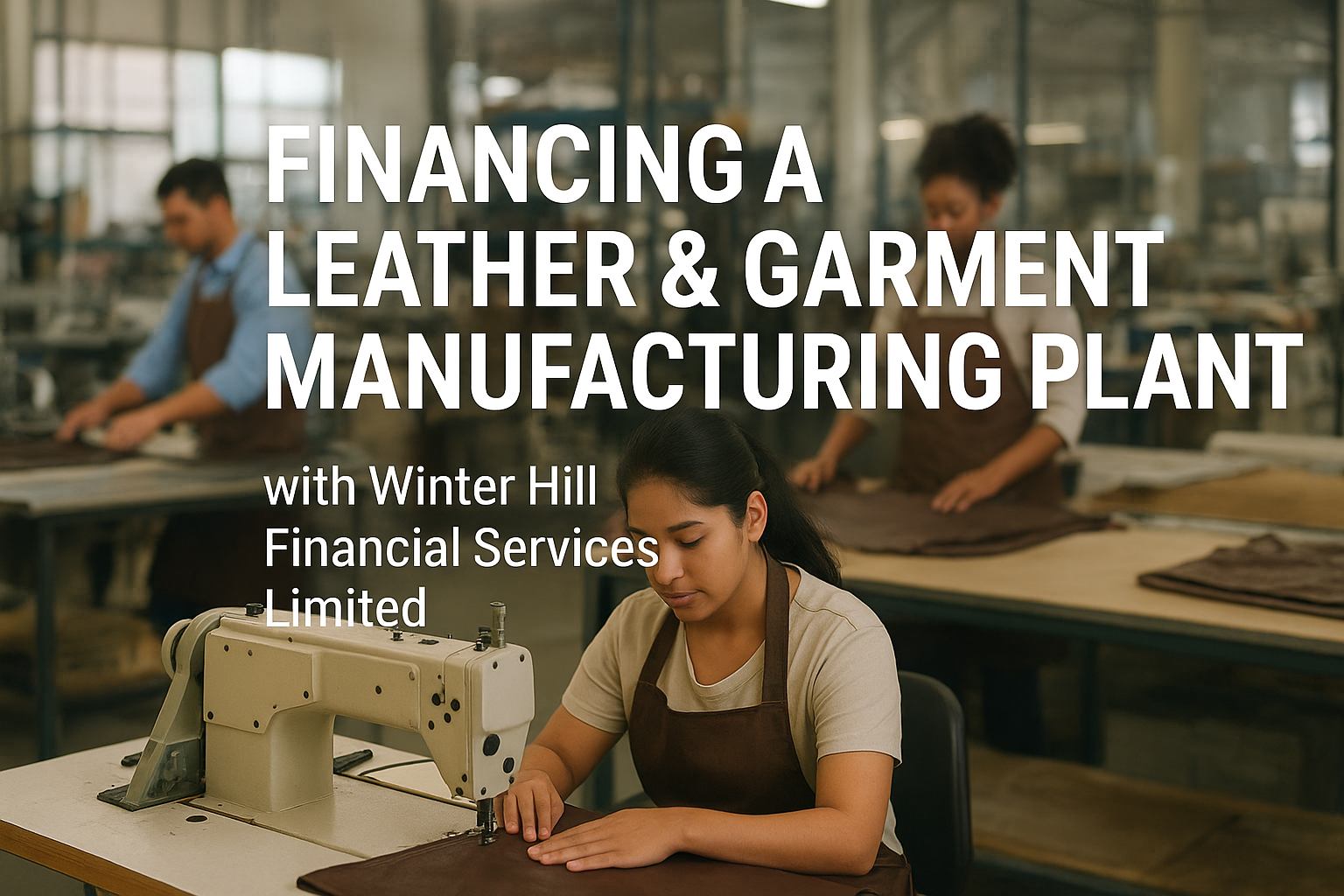
With Winter Hill Financial Services Limited
The apparel, leather, and garment sector continues to offer significant potential—but also faces heightened complexity due to global shifts in finance, supply chains, and sustainability requirements. For those considering the establishment or modernisation of a leather and garment manufacturing plant, the financing strategy must be equally robust, future-facing, and aligned with current market realities. In this overview, we’ll walk you through the major levers—from export dynamics and workforce productivity, through investment structures, promotion instruments, and the financing vehicles available—to provide a comprehensive guide.
1. Sector Opportunity: Leather & Garment Export Volumes and Earnings
The global manufacturing landscape is evolving. According to industry outlooks, manufacturers face a challenging environment but also meaningful investment opportunities—construction spending in manufacturing facilities hit a new record of US$238 billion in June 2024. Deloitte United Kingdom In apparel, leather, and garment processing, export performance remains a key driver of growth: strong export volumes translate into foreign earnings, help amortise plant investment, and underpin financing credibility.
For a leather or garment plant looking to attract capital, the export dimension is vital: consistent export earnings de-risk cash flows, enhance creditor confidence, and support servicing of debt. Moreover, in light of weaker business investment globally (in advanced economies median net investment is down to 1.6 % of GDP), the competitiveness of export-oriented manufacturing becomes ever more important. Financial Times
In short, when you plan the plant, you must map projected export volumes, anticipated earnings in hard currency (where relevant), and align your financing plan accordingly.
2. Workforce, Productivity, and Manufacturing Process
A modern leather & garment process industry plant’s strength lies not merely in equipment, but in workforce capability, productivity, process flows (cutting, finishing, leather-tanning, garment-assembly), and operational metrics. When building the financing case, you’ll want to address:
- The size of your workforce (skilled and semi-skilled) and planned growth.
- Productivity metrics: output per worker, yield losses, scrap/leather waste, and garment defect rates.
- Process-flow considerations: how leather treatment links to garment assembly, the integration, or modular layout.
- The up-gradability of the plant: ability to adopt automation, robotics, or advanced finishing techniques.
In a world where finance teams increasingly emphasise agility, scenario-planning, and digital integration (see latest trends in manufacturing finance), this becomes even more critical. OneStream Software+2Deloitte United Kingdom+2
Therefore, quantify your workforce plan, link it to productivity improvements, and show how that underpins your cost-structure and cash-flows.
3. Financing Structure for a Leather & Garment Processing Plant
Having defined your export and productivity assumptions, the next step is to structure your financing. Key elements include:
- Equity vs debt mix: how much capital you raise from owners/investors versus borrowing.
- Term of debt: medium- to long-term financing is preferred for plant, since heavy-capital asset investments are best amortised over longer periods.
- Fit-out and working capital: manufacturing plants require not just equipment, but working capital (raw materials, inventory, labour), especially if export financing cycles are long.
- Risk mitigation provisions: currency risk (if exports are in foreign currency), input-cost inflation (raw hides, leather chemicals, labour), supply‐chain disruptions. Finance teams today emphasise scenario-planning and agile governance to deal with these very issues. Deloitte United Kingdom
- Repayment schedule: align repayments with projected cash flows from production, garment shipments, and exports (ideally with some cushion for unforeseen delays).
In short: you want a financing structure that reflects the plant’s lifecycle, production ramp-up, export timing, and risk profile.
4. Investment Promotion Instruments for the Processing Plant
To support financing, there are multiple “investment promotion” mechanisms you should explore:
- Government incentives or subsidies for manufacturing, especially in regions looking to promote leather/garment exports or advanced textiles.
- Export-credit support: many countries have export financing, export credit guarantee schemes, or concessional financing for export-oriented manufacturing.
- Tax incentives: accelerated depreciation, tax holidays, or manufacturing‐zone benefits.
- Grants or soft loans for “modernisation” (equipment upgrade, automation, digitalisation), which can reduce your financing burden.
- Partnering with specialist advisers, like Winter Hill Financial Services Limited, which can help structure and package the investment-promotion case for lenders or investors. (More on that below.)
Such instruments improve your financing profile by reducing upfront cost, mitigating risk, and improving projected return on investment.
5. Access to Financing for a Leather & Garment Processing Plant
Accessing financing today is shaped by broader global financial trends: digitalisation, heightened transparency, ESG (environmental, social, governance) requirements, and the need for agile scenario-planning. Donnelley Financial Solutions (DFIN)+1
From a manufacturing perspective:
- Lenders will ask for strong business cases, audited projections, clear export-contracts and evidenced productivity improvements.
- Equipment-leasing companies or asset finance providers will want to see the assets being financed are high quality, maintainable, and have residual value supported by the secondary market or alternative use.
- Asset refinancing is increasingly used: once you own valuable manufacturing equipment, you may refinance that asset to release funds for expansion or working capital.
- Non-traditional financing: for example, supply-chain financing, export‐financing structures, or blended finance (where a development bank or manufacturing‐zone authority co-invests).
In a world of global volatility (geopolitical, inflation, supply‐chain shock) the ability to show resilience, scenario planning and transparent reporting boosts your chances of securing favourable terms.
6. Types of Financing for a Leather & Garment Processing Plant
There are several tailored financing instruments you should explore, including:
Asset Financing
- Equipment Leasing: You lease manufacturing equipment (e.g., cutting machines, garment assembly lines, leather-tanning vats) rather than purchase them outright. Benefits: lower upfront capital, possibility of maintenance included in the lease agreement, and easier upgrade cycles.
- Asset Refinancing: Once the plant is operational and you own high-value equipment, you may refinance those assets to raise further funds—perhaps for expansion, working capital, or new product lines.
Benefits of asset finance:- Access to high-tech equipment you may not be able to afford outright.
- With some leasing agreements, the finance provider may take responsibility for maintenance.
- It’s a widely available financing option in manufacturing.
- In the case of asset refinancing, you unlock funds against valuable assets you already own—improving liquidity without diluting ownership.
Working Capital / Export-Crediting
- Pre-export financing: raw materials (leather hides, fabrics, thread) must be procured well ahead of production and export. A working‐capital facility can support that.
- Post-export financing: bridging the gap between shipment and receipt of export payments.
- Currency hedging or risk mitigation financing: since export earnings may be in foreign currency, you may need hedging instruments or foreign-currency-denominated financing.
- Manufacturers today must consider cost inflation (raw hides, shipping, energy, labour) and plan financing accordingly.
7. The Role of Winter Hill Financial Services Limited
Winter Hill Financial Services Limited brings integrated technical consultancy and financial structuring expertise. As planners, analysts, design specialists, and financial advisers, their role for a leather & garment processing project includes:
- Structuring your financing package—from asset-finance, leasing, refinancing—to working-capital and export‐crediting.
- Advising on investment incentives, government promotion programmes, tax optimization, and export-earning strategies.
- Supporting your business case to lenders/investors—embedding modern financial reporting, risk modelling, scenario planning, and productivity metrics (which lenders now demand).
- Assisting with the implementation of modern manufacturing layouts, process flows, and equipment specification—all of which strengthen your financing credibility.
If you’re considering modernising or building a new leather and garment processing plant, contacting a specialist like Winter Hill Financial Services Limited will help you access tailored funding and technical structuring support.
📞 Phone: +44 74 1346 7328
🌐 Website: winterhillfinancialltd.com
FinancialServices #BusinessFinancing #InvestmentStrategy #BusinessGrowth #CorporateFinance #FinancialConsulting #SMEFinance #EconomicDevelopment #GarmentManufacturing #LeatherIndustry #TextileIndustry #ApparelManufacturing #SustainableFashion #FashionIndustry #LeatherProcessing #TextileProduction #Industry40 #SmartManufacturing #Automation #IndustrialInnovation #DigitalTransformation #ManufacturingTechnology #ModernFactory #WinterHillFinancial #WinterHillFinance #ManufacturingFinance #PlantInvestment #FinancingGrowth #LeatherAndGarmentFinance