
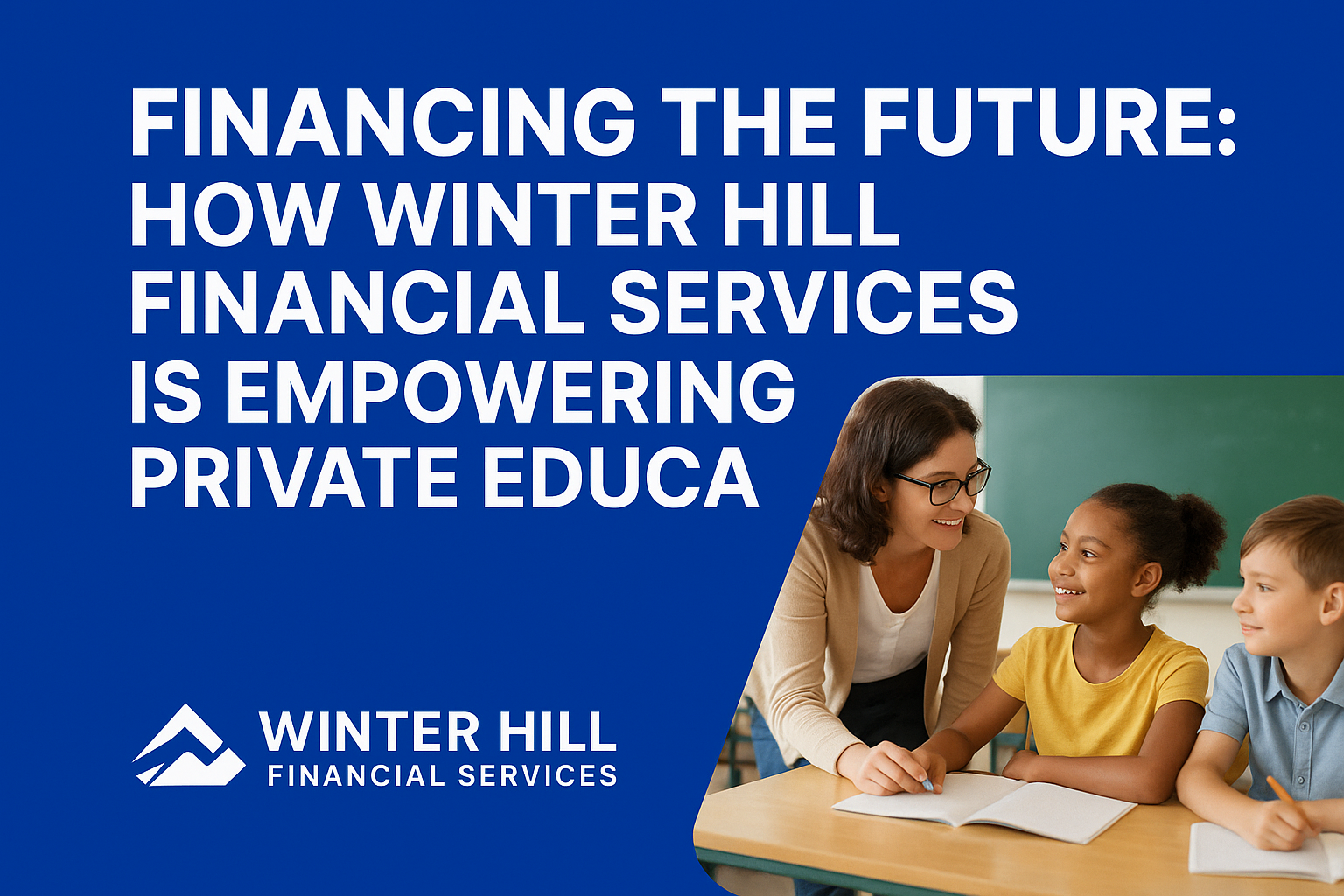
Financing the Future: How Winter Hill Financial Services Is Empowering Private Education Through Innovative Funding Solutions

Education as the Foundation of a Prosperous Future
Education is more than a human right — it is the cornerstone of sustainable development and a catalyst for social and economic growth. In today’s world, where technology and knowledge shape opportunity, education remains the most powerful tool to break the cycle of poverty, reduce inequality, and promote global stability.
Yet despite global progress, the education gap remains staggering. According to recent UNESCO data, over 260 million children and adolescents worldwide are still out of school, and nearly 617 million fail to meet basic proficiency levels in reading and mathematics. This means that nearly half of the world’s children are being denied the chance to reach their full potential.
At Winter Hill Financial Services, we believe that quality education should not be a privilege — it should be a universal right. By providing innovative financial instruments and long-term funding solutions, we help private schools and educational entrepreneurs bridge the financial gap that prevents many communities from accessing quality learning environments.
The Role of Finance in Expanding Private Education
Private schools play a critical role in supplementing public education systems, especially in low- and middle-income countries, where government resources are often stretched thin. These institutions frequently provide innovative, high-quality education tailored to community needs — but they face significant financial barriers.
Funding challenges can range from high construction costs to limited access to affordable credit lines. That’s where Winter Hill Financial Services steps in — offering tailored financing solutions designed to empower private education providers.
Our goal is simple yet transformative: to connect private sector capital with educational opportunity, ensuring that every child, regardless of geography or income, has access to a quality learning environment.
Understanding the Cost of Financing a Private School
Building or expanding a private school is a substantial investment that requires strategic financial planning. Beyond initial construction costs, schools must plan for operating expenses such as teacher salaries, facility maintenance, and technology integration.
As a general guideline:
- If a school expects to collect $100,000 in tuition twice per year, it should maintain at least $200,000 in start-up capital to sustain operations before tuition revenue begins to flow.
- For institutions collecting $500,000 in annual tuition, a $150,000 start-up reserve is typically advisable to ensure stability during enrollment cycles.
This kind of foresight allows educational institutions to remain operational, maintain quality, and avoid disruption during the early years of establishment.
Sources of Financing for Private Schools
Accessing capital for private education can come from multiple channels. Each option carries its own benefits and limitations, and often a combination of funding sources provides the most sustainable approach.
1. Personal Funding
Many education entrepreneurs begin with personal savings or investments. While this approach demonstrates strong commitment and financial responsibility, it also carries personal risk. It’s essential to maintain detailed records and establish a realistic repayment plan to reimburse personal funds once the school becomes profitable.
2. Grants and Educational Aid
Grants can be a valuable source of non-repayable funding, though competition is often fierce. Various organizations — including international NGOs, educational foundations, and philanthropic institutions — provide grants for private schools focusing on underserved communities or innovative learning models. Winter Hill Financial Services offers advisory support to help clients identify and pursue appropriate grant opportunities.
3. Government Programs
Some countries provide funding assistance through small business initiatives or educational development funds. For example, programs under Small Business Administration (SBA)-style frameworks may offer low-interest loans or partial guarantees. However, the qualification criteria can be strict, and such programs may not be sufficient as a primary funding source.
4. Commercial Banks and Financial Institutions
Traditional banking channels offer business loans, lines of credit, or construction financing. However, lenders often require extensive documentation, a robust business plan, and significant collateral. Interest rates and repayment schedules can also vary widely depending on market conditions and creditworthiness.
Winter Hill Financial Services: A Partner in Educational Transformation
Recognizing the challenges faced by private school investors and operators, Winter Hill Financial Services Limited has developed a suite of specialized financial products to support educational growth across diverse markets.
Our offerings include:
- Long-Term Educational Loans — designed to support infrastructure development, expansion projects, and modernization initiatives.
- BG/SBLC Monetization — allowing clients to leverage bank guarantees (BG) and standby letters of credit (SBLC) for immediate liquidity.
- SME Financing Solutions — empowering small and medium-sized enterprises (including private school startups) with tailored funding and advisory services.
- Corporate Refinancing — available for operational schools seeking to restructure debt or finance expansion.
- Flexible Currency Options — loans available in euros or other currencies upon client request.
- Up to 100% Investment Financing — providing full capital coverage for approved educational projects.
What sets us apart is not just access to funding, but our commitment to affordable finance. With interest rates as low as 2% annually, Winter Hill Financial Services ensures that educational institutions can focus on their mission — not their debt burden.
Investing in Education Is Investing in Humanity
The global education crisis is not just a moral challenge — it is an economic one. Studies show that each additional year of schooling can increase a person’s income by up to 10%, while countries that invest in education experience faster GDP growth and more resilient economies.
By financing private education projects, investors contribute to a ripple effect that strengthens communities, empowers women and girls, and builds a more equitable world.
At Winter Hill Financial Services, we see education not only as a social good but as a strategic investment in the world’s future workforce and innovators.
Partner With Us
Whether you are planning to build a new school, expand an existing institution, or modernize your educational infrastructure, Winter Hill Financial Services Limited is ready to partner with you every step of the way.
Together, we can transform financial resources into opportunities — and opportunities into brighter futures.
Contact Winter Hill Financial Services Limited today to learn more about our education financing programs and begin your journey toward sustainable impact.
📞 Phone: +44 74 1346 7328 🌐 Website: winterhillfinancialltd.com 📧 Email: info@winterhillfinancialltd.com