
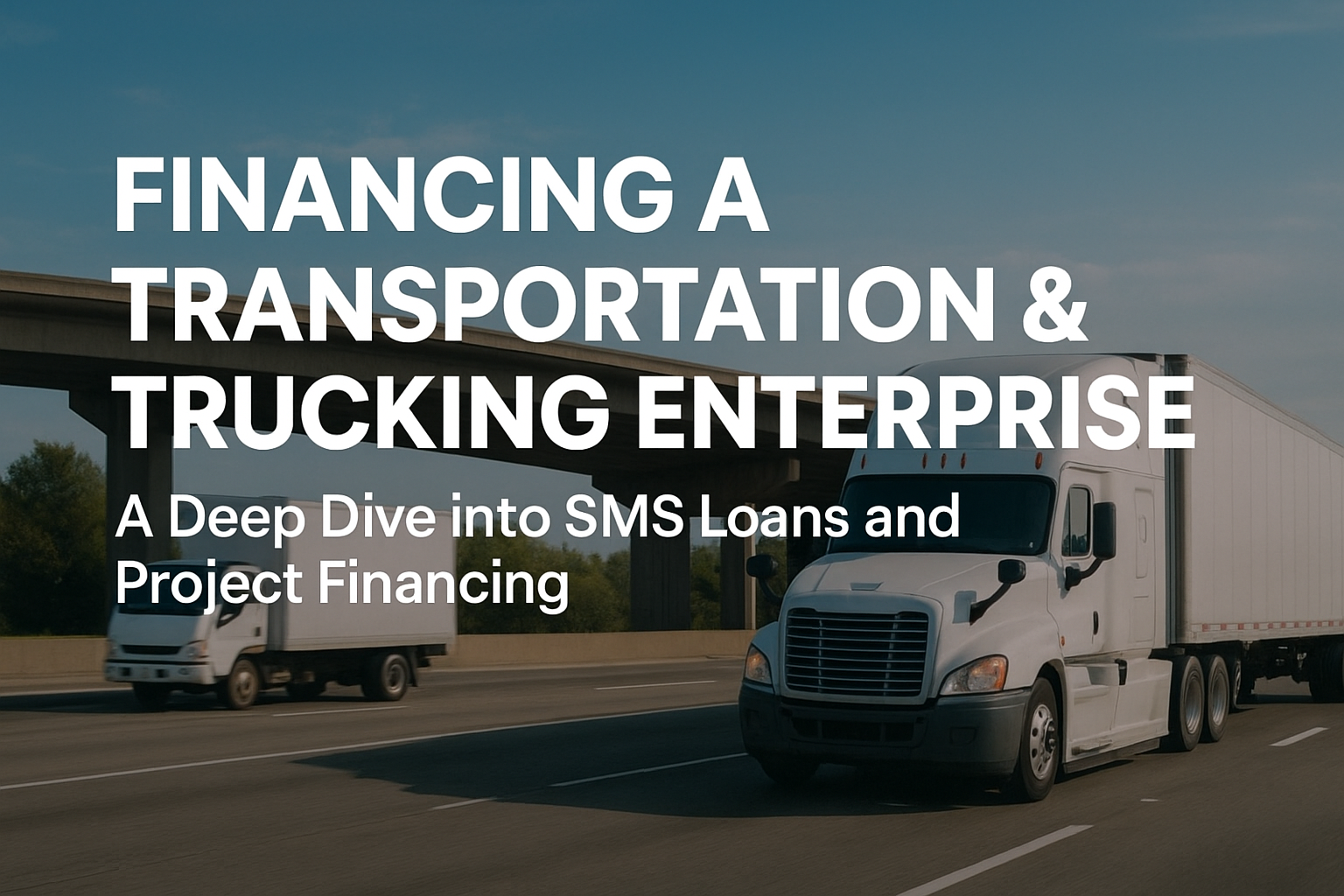
Financing Transportation & Trucking Enterprises in 2025: The Power of SMS Loans and Project Financing.

By Winter Hill Financial Services Limited.
Introduction: Driving the Global Economy Forward
The transportation and logistics sector remains one of the most vital engines of global commerce. As of 2025, the global transportation market is valued at over USD 8.5 trillion and is expected to grow at a compound annual rate of approximately 8% through 2032. Within this ecosystem, trucking and freight logistics form the critical arteries that keep supply chains moving—connecting producers, distributors, and consumers across continents.
Yet, despite its scale, the trucking industry remains capital-intensive and margin-sensitive. Rising operational costs, volatile fuel prices, and the ongoing push toward green and digital transformation are intensifying financial pressures. In such an environment, access to structured financing—including innovative instruments such as SMS loans—has become not just beneficial but essential.
This article explores how project financing models, particularly Structured Medium-to-Long-Term (SMS) Loans, can be tailored to the transportation and trucking sector. It also examines how aligning financial statements with global standards (IFRS, US GAAP) can enhance transparency, improve lender confidence, and unlock more favorable credit terms.
The Financial Landscape of the Global Transportation Sector
Macroeconomic Trends Shaping 2025
The global freight ecosystem continues to evolve under the combined influence of e-commerce growth, geopolitical realignments, and sustainability mandates:
- Freight diversification: Road and rail remain dominant in regional markets, while air and maritime freight rebound strongly post-pandemic.
- Environmental compliance: Nations across the EU, North America, and Asia-Pacific are tightening emissions standards, introducing CO₂-based tolls and incentivizing clean fleet adoption.
- Capital reinvestment pressure: Operators must modernize fleets, digitize logistics systems, and comply with decarbonization mandates—all requiring substantial capital inflows.
- Labor and cost inflation: Persistent driver shortages and maintenance costs continue to erode operating margins.
The Financial Statement Perspective: What Lenders and Investors Expect
Transportation and trucking enterprises must present financial statements that are transparent, standardized, and forward-looking. Whether you’re a regional carrier or a cross-border logistics player, your balance sheet and cash flow profile are the foundation of any financing conversation.
Key focus areas for investors and credit analysts include:
1. Revenue Recognition and Receivables
Freight operators typically recognize revenue upon delivery, but payment cycles can stretch from Net 30 to Net 60 days. Managing Days Sales Outstanding (DSO), provisioning for bad debts, and maintaining strong accounts receivable turnover are crucial.
2. Asset Capitalization and Depreciation
Fleet assets—trucks, trailers, and containers—dominate the balance sheet. Depreciation schedules should align with useful asset lives and residual values, following IFRS 16 and ASC 842 standards for leases.
3. Working Capital Management
Because fuel, maintenance, and payroll expenses are front-loaded, many trucking companies operate with working capital deficits. Cash flow visibility and debt service coverage ratios (DSCR) are critical indicators of creditworthiness.
4. Leverage and Solvency Ratios
Given the heavy use of financed equipment, lenders assess debt-to-equity, fixed charge coverage, and EBITDA-to-interest coverage ratios closely. High leverage must be offset by predictable, asset-backed revenue streams.
5. Off-Balance Sheet and Structured Financing
Leasing and sale-leaseback structures must be properly disclosed to maintain compliance with international reporting frameworks. Transparent disclosures build lender confidence and reduce perceived credit risk.
Pro Tip: Always accompany audited financials with 3–5-year forward projections, including sensitivity analysis under different fuel cost and utilization assumptions.
Project Financing for Trucking: Building on Cash Flow Strength
Project financing differs from conventional corporate loans by focusing primarily on the cash flows generated by a specific project—such as fleet expansion or route development—rather than the borrower’s overall balance sheet.
For trucking companies, project finance might fund:
- The acquisition of a new electric or hybrid fleet
- The construction of a logistics hub or maintenance facility
- The regional expansion of freight operations
By using SMS loans as the central financing tool, operators can structure capital in a way that sustains operations while ensuring long-term growth.
Understanding SMS Loans in the Trucking Sector
What Is an SMS Loan?
An SMS Loan (Structured Medium-to-Long-Term Loan) is a financing structure typically ranging from 7 to 10 years, designed to align repayment schedules with the economic life of transport assets. It bridges the gap between short-term liquidity tools and traditional asset loans.
Core Features:
- Extended tenor: Up to 10 years, easing short-term cash strain.
- Amortization alignment: Payments structured to match vehicle depreciation.
- Refinancing capability: Consolidate or restructure existing truck or lease debt.
- Collateral integration: Security may include vehicles, receivables, or other transport assets.
- Interest efficiency: Charged only on outstanding balances, not full invoice amounts.
Strategic Benefits:
- Improved liquidity: Lower periodic payments free up working capital.
- Flexible refinancing: Easier restructuring of older truck loans.
- Enhanced capital planning: Provides a stable backbone for long-term investment.
- Collateral flexibility: Allows multi-asset pledges to optimize borrowing capacity.
Typical Use Cases:
- Fleet expansion or modernization
- Equipment refinancing
- Working capital replenishment
- Acquisition financing for new routes or operators
Complementary and Alternative Financing Instruments
To build resilience, trucking firms often blend multiple financing instruments:
1. Invoice or Freight Factoring
Converts receivables into immediate cash—vital for managing fuel, payroll, and maintenance. Factoring pairs well with SMS loans by covering short-term liquidity gaps while long-term projects remain financed.
2. Asset-Based Lending (ABL)
A revolving facility secured by trucks or receivables. Ideal for companies wanting a centralized credit line with flexible drawdown options.
3. Short-Term Bridge Loans
Used for seasonal cash dips or rapid asset acquisitions. Though more expensive, bridge financing provides tactical speed when timing is critical.
4. Standby Letters of Credit (SBLC) / Lines of Credit
Offer contingency funding for emergencies or delayed payments—serving as a financial safety net in capital-heavy operations.
Structuring the Financing Process
A robust financing roadmap typically follows these six stages:
- Capital Needs Assessment: Identify specific project goals—fleet renewal, new depots, or working capital stabilization.
- Financial Preparation: Audit financials, forecast cash flows, and model repayment scenarios.
- Instrument Selection: Blend SMS loans, factoring, ABL, or bridge facilities based on needs.
- Structuring and Negotiation: Define interest terms, covenants, and collateral requirements.
- Closing and Compliance: Execute agreements and monitor post-disbursement covenants.
- Refinancing and Optimization: Adjust structures as fleet values and market conditions evolve.
Example: A Blended Financing Solution
Company: Mid-sized freight operator with 150 trucks
Objective: Expand by 20 new trucks while managing working capital
Financing Structure:
- SMS Loan: $8M over 8 years at 7.5% fixed rate
- Invoice Factoring Facility: $2M monthly receivables limit
- Asset-Based Revolver: $1.5M tied to existing fleet assets
Outcome:
- New trucks acquired without draining liquidity
- Smooth cash flow supported by factoring
- Strong lender confidence due to diversified financing layers
Risk Management: Navigating Sector Challenges
The trucking sector faces structural risks—both financial and operational.
Key Risks:
- Residual value decline: Asset depreciation accelerated by regulatory fleet changes
- Fuel price volatility: A direct hit to margins if not hedged
- Client credit risk: Factoring and ABL are reliant on invoice collectability
- Covenant breaches: Over-leverage can trigger default clauses
- Regulatory change: New emissions rules can force early fleet turnover
- Labor shortages: Escalating wage pressures and retention costs
Mitigation Strategies:
- Conservative financial modeling
- Hedging against fuel price spikes
- Maintaining liquidity buffers
- Diversifying client base
- Proactive lender communication
Best Practices for Securing Transportation Financing
- Maintain audited, IFRS/GAAP-compliant financials
- Use scenario modeling to test resilience under fuel and rate shocks
- Diversify funding sources—layer short and long-term instruments
- Negotiate flexibility on covenants and amortization terms
- Be proactive with lenders—transparency builds trust
- Plan refinancing early—avoid concentration risk as assets age
Conclusion
Financing a trucking or logistics enterprise in 2025 demands both strategic foresight and financial agility. With capital intensity rising and sustainability mandates tightening, structured solutions like SMS Loans—integrated with factoring, ABL, and standby facilities—offer a pathway to sustainable growth.
By adhering to global accounting standards, presenting robust financial transparency, and embracing innovative funding models, transportation businesses can position themselves for expansion while maintaining liquidity and operational flexibility.
Winter Hill Financial Services Limited stands ready to support enterprises in structuring bespoke, compliant, and future-ready financing solutions for the evolving transportation economy.
Contact us, Winter Hill Financial Services Limited, for any type of trucking financing as mentioned above.
 Phone: +44 74 1346 7328
 Website: winterhillfinancialltd.com
 Email: info@winterhillfinancialltd.com
#FinancialServices #BusinessFinance #CorporateLending #ProjectFinance #InvestmentStrategy
#TransportationFinance #TruckingIndustry #LogisticsFunding #FleetManagement #SupplyChainFinance
#SustainableTransport #GreenLogistics #GlobalEconomy #InfrastructureInvestment #FutureOfMobility